Access control systems play a critical role in modern building security. They ensure that authorized individuals can safely and conveniently access designated areas—while keeping unauthorized people out. A well-designed system also simplifies facility management by eliminating the need to replace lost keys, track down keys from former employees, or guess who currently has access to certain areas.
Regardless of the technology involved, every locking system ultimately relies on a physical object or credential to release the secure lock. The choice of credential depends on your facility’s needs, budget, security requirements, and desired level of monitoring. Common credential types include traditional keys, combinations, cards, and even biometric identifiers like fingerprints.
Below is an overview of the most widely used access control methods and how they compare.
Stand-Alone Locks
As the name suggests, stand-alone locks are self-contained, battery-powered units that function as “all-in-one” access control systems.
Advantages:
- Quick installation — often fully operational within minutes
- No wiring or network infrastructure required
- Ideal for small facilities or isolated doors
Disadvantages:
- Not connected to a centralized monitoring system
- Limited scalability for larger buildings
- Audit trails require a hand-held reader to extract data
Stand-alone locks are a convenient, cost-effective option for simple access control needs or remote locations.
Proximity Readers
Proximity readers are the most commonly used credential readers in commercial access control systems. They rely on cards or fobs that communicate with the reader using wireless technology.
Most proximity systems fall into two main categories:
- RFID (Radio-Frequency Identification)
- Bluetooth-enabled readers that allow smartphones to serve as credentials
Benefits include:
- Low cost per credential
- Fast, contactless entry
- Ability to combine access cards with photo ID for added security
Their ease of use and affordability make proximity readers a top choice for offices, schools, healthcare facilities, and large commercial buildings.
Keyswitches
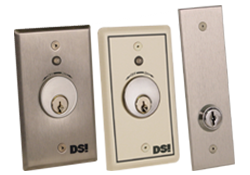
A keyswitch bridges the gap between mechanical and electronic security. It uses a physical key to activate an electronic locking mechanism, providing the familiarity of key operation with the enhanced functionality of electronic auditing.
Key advantages:
- Integrates into a monitored electronic access system
- Provides audit trails through the connected network
- Useful in areas where key-based control is still preferred
Key disadvantages:
- Physical key retention is required
- Choosing the correct configuration is important
Keyswitches are often used in transition spaces upgrading from mechanical hardware to full electronic access control.
Keypads
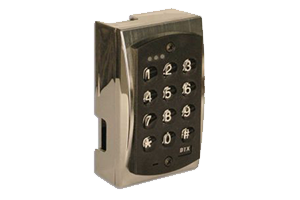
Keypads are one of the simplest and most recognizable forms of access control. Users enter a numeric code to unlock the door.
Pros:
- Easy to use
- Cost-effective
- Ideal for single-door or low-traffic areas
Cons:
- Lower security, as codes can be shared, written down, or observed
- Limited tracking unless each user is assigned a unique code
- Requires regular code changes to maintain security
Keypads are a practical solution for low-risk spaces but less suitable for high-security environments.
Biometric Systems
Biometric access control provides the highest level of security by verifying physical characteristics unique to each user. Common biometric identifiers include:
- Fingerprints
- Hand geometry
- Retinal or iris scans
Advantages:
- Extremely difficult to forge or share
- No need for physical keys or cards
- Provides precise audit trails
Considerations:
- Higher upfront cost
- Requires quality equipment and proper user enrollment
- May need integration with other systems for multi-factor authentication
Although more expensive, biometrics offer unmatched security and accountability for sensitive facilities.
Choosing the Right Access Control Method
The best access control solution depends on your building’s layout, security needs, user population, and long-term scalability goals. Many facilities use a combination of methods. For example, proximity readers for most employees, biometric systems for high-security areas, and stand-alone locks for remote entries.
Understanding the differences between these technologies will help you design a system that improves security, enhances convenience, and supports the overall management of your building.